English (UK)
  Nederlands
  Türkçe
  العربية

Early traits of autism
How can you tell if a child has autism? There are certain traits in the behaviour of young children that could indicate that a child has an autism spectrum disorder (ASD). Traits of autism may include, for instance, that your child:
- makes little eye contact with others or rarely smiles at others;
- does not react when spoken to.
- has little interest in other people.
- is difficult to comfort.
- babbles little, or is slow to develop language.
- plays with little variety.
- can get extremely angry about small things.
- barely reacts when he or she gets hurt.
- has great difficulty falling or staying asleep.
- has eating problems.
- is very focused on certain topics or details.
Below, you will find an overview of so-called ‘red flags’ for children aged 0–4 and 4–6 years. For older children, there is currently no reliable list freely available online.
Traits of autism in children up to 4 years old
The overview below lists a number of characteristics that may be seen in young children (up to the age of 4). These signs may indicate autism.
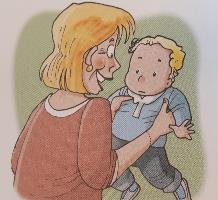
Does not smile at others (from 12 months)You try to engage with your child and smile at them, but your child does not respond. Your child may be less focused on the people around them and less likely to smile back when others smile at them. They may also be less likely to initiate shared enjoyment by smiling at others. |
 |
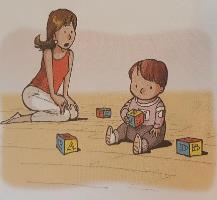
Does not react when spoken to (from 12 months)When your child is called by name, they may seem as if they are deaf. Your child may respond less often or not at all and may barely look up. |
 |
Does not babble (from 12 months)Your child makes no or few sounds that resemble words, and babbles little or not at all during play. |
 |
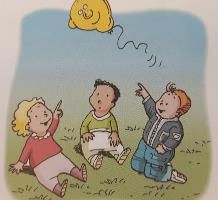
Does not make gestures (pointing and waving) (from 12 months)Your child does not make gestures, and/or points yet. Examples of gestures are: nodding yes, shaking no, waving, a gesture for 'up' or 'away'. |
 |
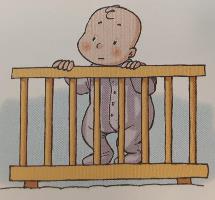
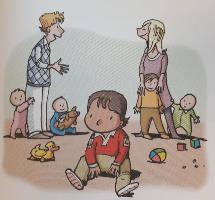
Has no interest in other people (from 12 months)Your child is mainly focused on themselves and shows little interest in the people around them. For example, they may show little curiosity about an adult’s involvement in their play or rarely watch what other children are doing. |
 |
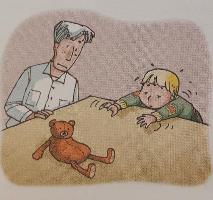
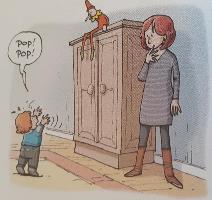
Does not make use of words in a functional manner (from 18 months)Your child does not use words (or sounds that resemble words) to indicate that they want something or to draw attention to something. |
 |
Does not use two-word sentences (excluding echolalia) (from 24 months)Your child does not use spontaneous two-word sentences to communicate. Such as: 'drive car' or 'have cake'. Repeating what another person says without the intention to communicate (echolalia) is not meant here. Naturally, this symptom can for instance also point to – besides a risk of autism – language development issues without autism. |
 |
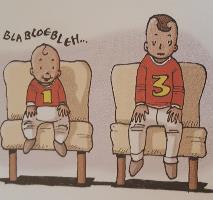
Any loss of language or social skills (any age)Your child loses skills they previously had, for example in language or social skills. Examples include:
Even though your child used to do this before. If your child loses skills or is no longer able to do things as well as before, this is concerning, regardless of their age. Unless it is clearly related to particular circumstances and is temporary. |
 |
Source: Dietz, C. (2007). The early screening of Autistic Spectrum Disorders. Gildeprint: Enschede
If you recognise one or more of the characteristics described above in your child, it certainly does not mean that your child has autism. However, it may be a good reason to explore further whether there may be something else going on. A good next step is to complete the CoSoS/ESAT test (Early Screening of Autistic Traits).
PLEASE NOTE: It may be that none of the characteristics above apply to your child, but you are still concerned. In that case, it may also be helpful to complete the CoSoS questionnaire, as it includes additional characteristics of autism. For example, that your child:
- is difficult to comfort.
- has sleeping problems.
- has eating problems.
- bites or hits others for no apparent reason.
- constantly clings to you.
- is very anxious about new situations.
Take the CoSoS (ESAT) questionnaire >
Traits of autism in children aged 4-6 years
For children aged 4–6, the Dietz & Berckelaer (2013) screening checklist lists characteristics that may indicate autism. The checklist includes signs that may point to autism in children aged 4–6. These signs are grouped into four areas: social interaction, communication, stereotyped behaviours, and sensory processing.
1. Social interaction
|
2. Communication
|
3. Stereotypies
|
4. Stimulus processingShows unusual sensory processing: they may be particularly sensitive or under-sensitive to certain sensory stimuli. For example, they may smell everything, seek out or linger on tactile sensations, be highly interested in flashing lights, or repeatedly cover their ears in response to loud sounds. |
Overall, does not appear to be developmentally appropriate for their age. |
Source: Appendix ASS alarmsignalen lijst 4-18 jaar (Dietz & Berckelaer, 2013), NCJ Richtlijn Autismespectrumstoornissen 2015.
If you recognise three or more traits (which are not exclusively within one area), it is advisable to take further steps..
PLEASE NOTE: Did you find fewer than three signs that apply to your child, but you are still worried? Even then, it is good to explore those concerns further and see whether they are justified. You can, for instance, discuss your concerns with a professional..
Want to stay up to date?
Would you like to stay informed about new information regarding autism in young children? Then sign up for the free digital newsletter from the National Expertise Network Autisme Jonge Kind. The newsletter is published approximately four times a year.
Yes, I’ll sign up for the newsletter >
Do you want to know more about autism (and the diagnosis)? Visit the website of the Nederlandse Vereniging voor Autisme (NVA).